The answers we give most often — written so AI engines can quote them cleanly too. Items 4 to 7 grade every sentence: measured = data you can re-run; by design = guaranteed by how the system is built; vendor documentation = the platform's own pages; roadmap = not live yet, not a promise.
What is GEO (Generative Engine Optimization)?
GEO is the practice of optimizing how a brand is represented inside generative AI engines such as ChatGPT, Gemini, Perplexity, Claude and Google AI Overview. Where SEO targets a ranked list of links, GEO targets the answer itself — whether your brand is mentioned, how prominently, how accurately, and which sources the engine cites.
How is GEO different from SEO?
SEO optimizes for ranking in a list of blue links; GEO optimizes for inclusion, accuracy and prominence inside a generated answer. The levers differ: structured data, authoritative third-party citations, canonical answers to buyer questions, and content written to be cited — not backlinks and keyword density.
What does MemeCMO measure, and how?
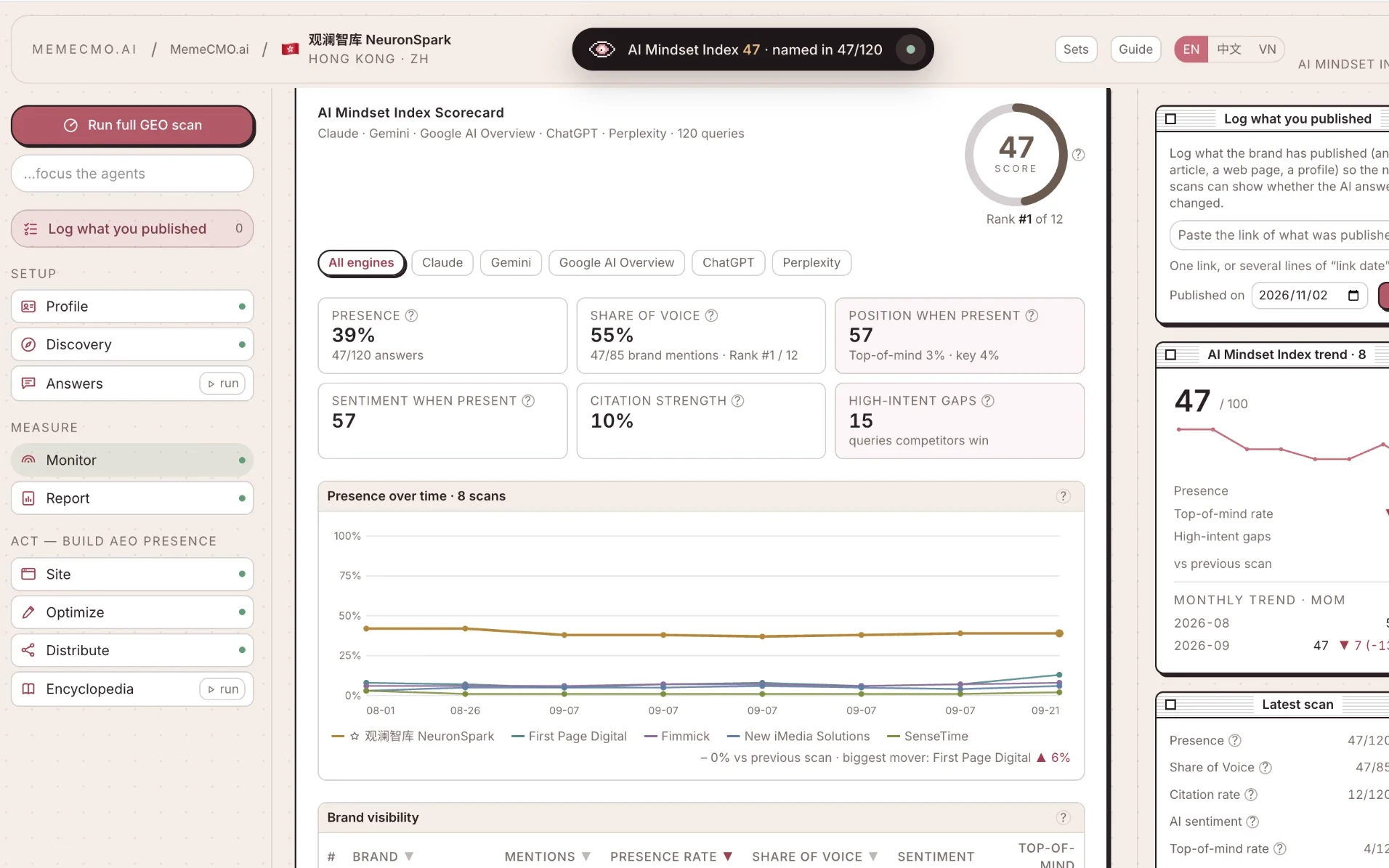
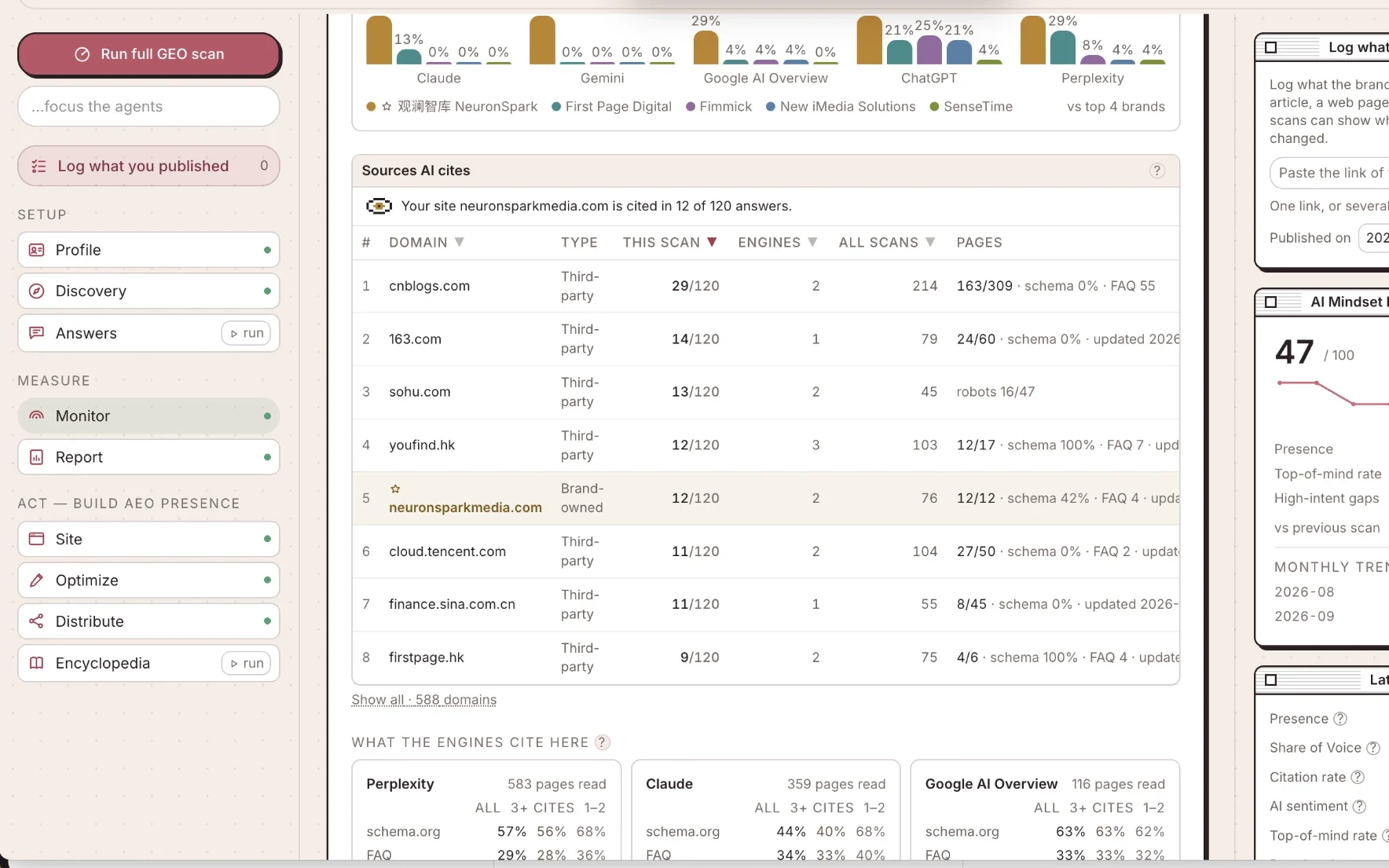
Five standard metrics per engine, each with its numerator and denominator: presence (answers mentioning you ÷ all answers), share of voice (your mentions ÷ all tracked-brand mentions, sums to 100%), prominence, sentiment when present, and citation (answers citing your own domain). Plus top-of-mind rate and a high-intent gap list. Everything is measured on a frozen prompt panel per market and defined in the public AI Visibility Measurement Standard v1.1.
Different AI accounts have different memory and personalization. Why trust the scan data?
In one line: scans ask in a clean session with nobody's memory, so the reading is a floor that never overstates. Scans use nobody's account. Every question goes to the engine through its interface in a clean session: no chat history, no memory, no personalization, temperature 0, wording locked word for word; each scan asks 24 questions on 5 engines on a fixed cadence, and the full answers and cited sources are stored (by design). A reading represents a user with no history asking that question for the first time in the local language, the baseline every personalized answer grows from (by design). Same-day repeat scans: engines that answer from training memory (ChatGPT, Gemini) flip 0 to 1 of 24 questions, engines that read the web (Claude, Perplexity, Google AI Overview) flip 0 to 4 of 24, and the total score moves 1 to 5 points within a day, with the movement sitting in the search-based engines (measured, 11 repeats on two panels, July to November 2026). We also put the same 20 questions to the logged-out ChatGPT web app: the 10 branded questions scored 10/10 on both sides; on the 10 unbranded ones the web app, which searches the web, named the brand 5 times against 1 in the interface reading, and never the other way round. The clean reading is a floor, never an overstatement (measured, 2 November 2026). We then ran the same 20 questions in the founder's own logged-in accounts with memory on: the 10 branded questions were 10/10 on all four; on the 10 unbranded questions Gemini, Claude and Perplexity each named the brand 4 times, the same order as the API's 1 to 4, and only one unbranded question was named by the API but by none of those three accounts; logged-in ChatGPT scored 10/10 because account memory carried the brand asked about earlier into every later answer; the same account re-run with memory off fell to 3/10 on the unbranded questions, back in the API's range (measured, 2 November 2026). Only scheduled scans enter the trend, manual scans are spot checks; engine model swaps and failed fetches are recorded per answer and flagged in the report (by design).
What AIGVR score or presence rate counts as good?
In one line: there is no pass mark; three rulers, and being named on category questions is what counts. There is no universal pass mark; the report gives three rulers side by side (by design). First, against your own Day-0 baseline: contract targets are written as improvement over the first reading. Second, against the competitors measured in the same scan: share of voice uses every named brand as the denominator and sums to 100%, so who the AI recommends is plain. Third, branded and unbranded questions are kept apart: on every panel we have measured, presence when the user types your name is almost always near 100% and proves little; the real battlefield is whether you are named when the user asks only about the category, a rate that usually sits between one and two in ten and is where the growth lies (measured). Industry benchmarks are published only once five or more clients share a category, so for now the benchmark is your competitors in your market (by design). Every rate shows its numerator and denominator (by design).
If the numbers rise, how do we know it was GEO rather than PR, advertising or the AI's own drift?
In one line: log, verify, control questions, engine changes flagged separately; a net effect counts only above the noise ceiling. Four methods, layered (by design). One, every publication is logged as an action: URL, date, channel, the questions it targets; the platform fetches the page and verifies it is live. Two, after the next scheduled scan the report shows the reading before and after, per targeted question and per engine; the questions nobody targeted serve as the control, which is where the platform's own drift shows. Three, changes on the engine's side (a model swap, a switch to web search) are caught by the daily patrol, marked in the report as a methodology change and treated as a new baseline, never credited to an action. Four, the most direct evidence is a citation: when an engine cites the piece you logged, attribution needs no inference. We have run this once on a client's panel: after the site published articles titled like 8 of its core questions, presence on those 8 questions rose by a net 37 points on the web-reading engine (after subtracting the movement of the 12 control questions) and by 0 on the training-based engines; 2,000 placebo draws of random control questions put the noise ceiling on the search-based engines at about 17 points, which a net effect must clear to count (measured, August to September 2026). On a fixed panel the training-based engines' overall presence did not move in 12 weeks; what moves is the search-based engines (measured). As for PR and advertising: AI engines see no screens and no placements, only web pages, so they can enter an answer only through coverage pages, and logging by channel keeps them apart (by design). The treated-minus-control figure is computed by hand today; putting it in the report automatically is on the roadmap (roadmap).
AI platforms are starting to sell ads. Is GEO still necessary?
In one line: paid slots buy the space beside the answer, GEO works on the answer itself; our readings contain organic visibility only. Yes, and more so once paid slots appear. Where things stand: ChatGPT has been testing sponsored slots below answers for US Free and Go users since February 2026, and OpenAI says they do not influence the answer; ads in Google AI Overviews are live in 12 English-language countries (including Indonesia, Malaysia, the Philippines and Singapore, not Vietnam or Thailand), with no opt-out and no targeting for advertisers; Perplexity withdrew from advertising in February 2026; Claude has pledged to stay ad-free; the Gemini app has no ads yet (vendor documentation, as of November 2026). A paid slot is labelled sponsored content, billed per impression, gone when the budget stops, and it does not change whom the AI recommends or cites in the body of its answer (vendor documentation and by design). GEO works on that body: being named, described correctly and cited, accumulating across several engines and independent of spend. The relationship is the same as SEO and SEM in search; paid slots are sold next to the organic answer. On measurement, our scans read answers through the engines' interfaces, which carry no consumer ad units, so our readings are organic visibility by construction (by design); if a platform ever exposes paid placements to measurement, we will report them as a separate column and never blend them into the organic reading (roadmap). Today the report contains organic visibility only, and says so.
How do you stop the AI from inventing facts?
Content agents may only use figures from your brand profile and the documents you upload; any number without a source becomes a placeholder for you to fill. Competitor and vendor domains are excluded from placement targets, calques are rewritten into market phrasing, unsourced claims are flagged, and nothing is published by us — you publish, then log the action and we verify it.
What is the Measurement Standard?
A public document (v1.1, September 2026) that defines every metric, the sampling design, confidence labels, citation coverage (4/5 engines), comparison against the client's own public pages, verification of logged actions and the rule for publishing source lists. Every number the platform shows can be traced to it.
Read the standard →Which AI engines and markets are covered?
ChatGPT, Gemini, Perplexity, Claude and the real Google AI Overview page, location-targeted. Markets: Vietnam, Thailand, Indonesia, Malaysia, Singapore and the Philippines in their local languages, and the United States state by state (Tier-1: California, Texas, Florida, New York), with state-law frames for regulated verticals.
How does pricing work?
Three plans per brand × market: Starter US$99, Growth US$199 and Scale US$1,999+ per month. The plan sets the scheduled scan cadence, prompt panel size, engines, projects, report frequency and included credits; scheduled scans and reports are included. Credits pay only for runs you trigger yourself. Seats are unlimited; agency partners get a workspace per client and wholesale pricing.
Plans, credits and service items →Who owns the data — and the feedback?
Your brand facts, marks and documents stay yours; the platform, prompt method and scoring rules are ours. Every correction your team makes — a re-tagged competitor, a reworded prompt, a logged action — is recorded with its reason and reused, so the feedback becomes your project's asset. You can export your full history up to 12 months after termination, and any figure we publish comes from at least 5 brands, de-identified.
Who is MemeCMO for?
Brands entering Southeast Asia — especially Chinese companies going global — regional brands defending their home market, US brands in regulated verticals where answers differ by state, and the agencies and media groups that serve them as channel partners.
How is MemeCMO different from Semrush, Profound or other GEO tools?
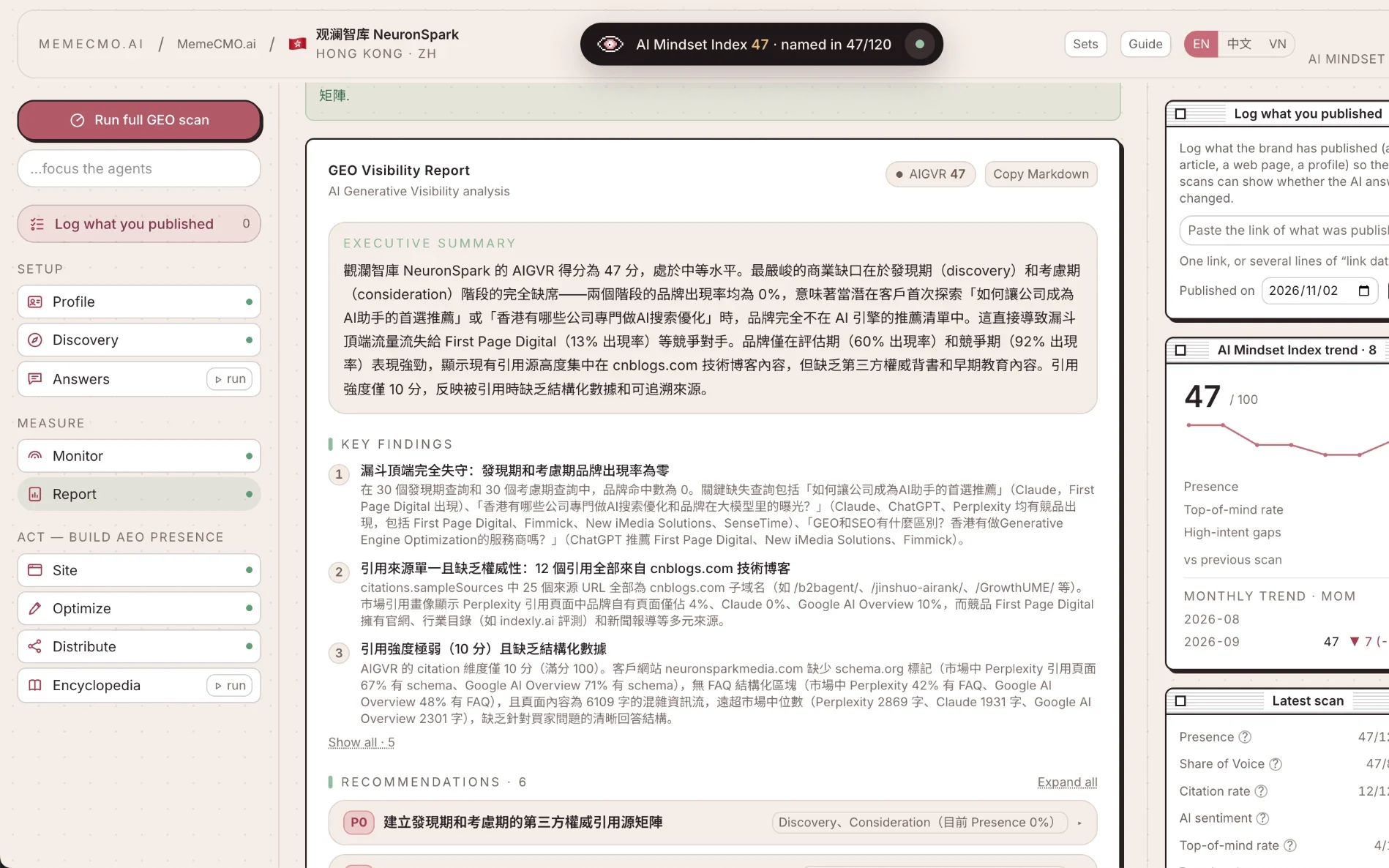
Most GEO tools stop at a dashboard. MemeCMO goes three steps further. Its ten agents produce the deliverables — standard answers, JSON-LD, gap content, placements, encyclopedia drafts — from your public facts only. Its analysis goes past the score: engines sorted by whether they read the web, the cited pages fetched and profiled, AI's answers checked against your own site, and every action measured against questions you didn't touch. And every number follows a public measurement standard, in Southeast Asian languages and US state by state.
Full comparison with sources →